“What should I do if the package sent is refused?”
“I want to know what measures I can take to prevent delivery rejection!”
Many companies are likely struggling with refused packages.
When a package is refused, companies may incur losses such as bearing return shipping costs or being forced to dispose of products.
Therefore, as the number of refused receipts increases, so do the losses, so companies need to take immediate measures to prevent refused packages.
This article explains:
- How to respond when a delivery is refused
- How to contact a customer who refused an order (with examples)
- Measures to prevent order refusals
Companies should read this article and take measures to prevent losses caused by refusal to receive items.
First, let’s understand why a customer might refuse to accept a delivery.
There are five main reasons why customers refuse to accept their orders:
- They no longer want the product they ordered.
- They couldn’t prepare the cash for cash-on-delivery.
- They failed to pick up the package within the storage period.
- They received something different from what they ordered.
- A family member mistakenly refused acceptance.
- It was a prank order.
We will explain each of these in detail.
目次
- 0.1 1. The customer no longer wants the ordered product.
- 0.2 They couldn’t prepare the money for cash on delivery.
- 0.3 Could not receive the package within the storage period
- 0.4 A different product arrived than the one ordered.
- 0.5 Family mistakenly refused to accept delivery
- 0.6 Malicious orders
- 1 For Businesses: 3 Ways to Deal with Refused Deliveries
- 2 [Examples] How to contact a customer who refused to receive an order
- 3 3 Reasons Companies Should Take Measures Against Refused Deliveries
- 4 Four Measures to Prevent Refusal to Receive
- 5 Summary
1. The customer no longer wants the ordered product.
Even if a product was purchased impulsively, the desire for it can wane before it arrives.
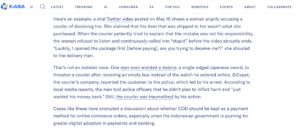
In fact, as reported in the Sankei Shimbun article below, cases of refusal to accept deliveries due to reasons like “I changed my mind” or “I don’t have money” are increasing, causing trouble for many companies.
However, you should not refuse to receive an item you have ordered simply because you no longer want it.
Companies should take a firm stance against people who refuse to receive items for such selfish reasons.
They couldn’t prepare the money for cash on delivery.
Payment methods that are prone to refusal of receipt are cash on delivery (COD) payments.
COD offers the advantage of allowing customers to prepare the payment by the time the product arrives, providing ample time for payment.
However, customers sometimes refuse to accept the delivery because they “couldn’t prepare the COD money by the time the product arrived.”
In such cases, since the reason is the customer’s self-centeredness, companies should take strict measures.
Could not receive the package within the storage period
In many cases, packages from delivery companies are returned because the recipient is unable to receive them within the storage period due to travel or business trips.
▼Storage periods for major delivery companies
Yamato Transport: 7 days including the initial redelivery notice date (extension of storage period not possible)
Sagawa Express: 8 days including the initial delivery date (extension of storage period not possible)
Japan Post: 7 days (extension of storage period possible for a maximum of 30 days by submitting a notice of absence)
*References: Yamato Transport, Sagawa Express, and Japan Post (Extension of storage period)
For products that take a long time from order to shipping, people sometimes forget they ordered them and are away from home for an extended period.
Therefore, to prevent customers from forgetting their orders, it’s recommended to clearly state the estimated shipping date in the order confirmation email for products that take a long time to ship.
A different product arrived than the one ordered.
If the customer receives a different product than what they ordered, there’s a high probability they will refuse delivery.
However, since the contents cannot be checked while packaged, mistakes are often pointed out after receipt.
In such cases, it is the shipping company’s mistake, so promptly send the correct product.
Additionally, for information on how customers can refuse delivery, please refer to the following article for details.
reference:KrASIA
Family mistakenly refused to accept delivery
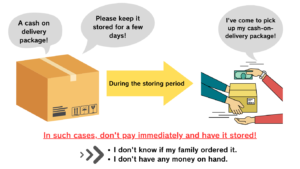
There are also cases where a family member living with you mistakenly refuses to accept the delivery.
Especially in the case of cash-on-delivery (COD) items, family members who are unaware that a COD item is arriving may become suspicious and refuse to accept it.
The reality is that many people don’t know that for COD items, payment can be deferred until within the parcel storage period of each delivery company.
Malicious orders
There are cases where people order products with no intention of purchasing them and then refuse to accept delivery as a prank.
Some prank orders are highly malicious, such as sending products via cash on delivery to someone else’s address.
Therefore, when you receive a prank order, don’t just give up; take a firm stance, such as considering legal action.
For Businesses: 3 Ways to Deal with Refused Deliveries
When a product is returned due to a refused delivery, many companies are unsure how to proceed.
Here are three different ways to handle package rejections, categorized by the reason for the refusal:
- Rejection due to the customer’s selfish reasons
- Rejection due to customer error
- Rejection due to company shipping error
We will explain each case in detail.
[Case 1] Refusal to receive due to customer’s selfish reasons
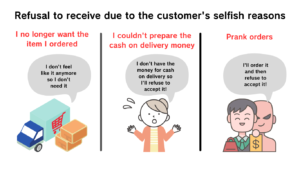
There are three main patterns of delivery refusal due to the customer’s self-serving reasons:
- The customer no longer wants the ordered product.
- The customer couldn’t prepare the cash on delivery.
- The order was a prank.
 Companies facing such situations should take strict measures, such as:
- Having the customer cover shipping costs
- Having the customer cover the cost of goods that are discarded due to refusal of receipt
- Considering legal action
- Adding the customer to a blacklist to prevent future purchases
Malicious refusal to accept, especially prank orders, can be repeated, so measures should be taken to prevent them from ordering again.
[Case 2] Refusal to receive due to customer error
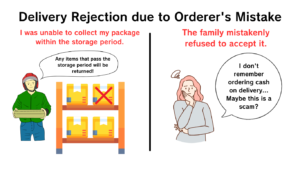
There are mainly two patterns of refusal to receive due to the customer’s mistake:
- The package could not be received within the storage period.
- A family member mistakenly refused to receive it.

To address such cases, companies should:
- Have the customer bear the full shipping cost when resending the product.
- Take precautions to prevent similar mistakes from happening again.
Mistakes happen to anyone, but you should have the customer bear the additional shipping costs.
[Case 3] Refusal to receive due to company shipping error
Cases of refusal to accept a product may occur if a different product from the one ordered was shipped, or if the product was damaged during shipping.
In such cases, promptly apologize and resend the correct product.
If it is clearly a company mistake, showing sincerity by issuing a coupon as a token of apology can prevent customer churn.
Useful resources for EC site construction and operation can be downloaded from the banner below, so please refer to them as well!
[Examples] How to contact a customer who refused to receive an order
When a product is returned by a delivery company due to a refusal to accept it, there are cases where the reason for the refusal is unknown.
Therefore, if the reason for the refusal is unknown, you need to contact the orderer to confirm.
An example of what to say in the confirmation contact is provided below.
When Contacting by Email
When a refused item is returned, first contact the customer by email to confirm.
Please refer to the following example email for customers who refused delivery.
Dear Mr./Ms. [Customer Name],
Thank you for shopping with [Shop Name].
We are writing to you today regarding an urgent matter concerning your recent order.
The product you ordered on [Date] has been returned to our shop due to refusal of receipt.
—- [Insert product information here] —-
We kindly request that you contact our shop immediately.
Please be aware that if the refusal of delivery is due to customer reasons, you will be responsible for the shipping fees, cash-on-delivery fees, and return processing fees. Please note that if we are unable to reach you for an extended period, we may consider legal action.
We apologize for the inconvenience, but we kindly ask for your prompt attention to this matter.
—- [Insert shop contact information here] —-
Here are three key points when contacting customers by email:
- State that the product was returned due to the customer refusing to accept it.
- Ask them to contact you urgently.
- Explain how to handle refusals to accept delivery that are due to the customer’s reasons.
Create an email message that conveys the urgency of the matter and makes it clear that we will take strict measures if the recipient continues to ignore our communications for selfish reasons.
When contacting by phone
When there’s no email response or you have enough time, call to confirm.
Please refer to the following example for a phone confirmation to an orderer who refused to receive the item.
Thank you for your continued business.
This is [Your Name] from [Shop Name]. I apologize for disturbing you during your busy schedule, but do you have a moment to talk?
Thank you for shopping with us the other day. I’m calling today about the item you ordered, which was returned to us by the delivery company due to a refusal to accept it.
On [Date], you purchased [Number] of [Product Name], is that correct? If you don’t mind, could you please tell us why you refused to accept the package?
If the customer refuses to accept the delivery due to their own circumstances
We sincerely apologize, but in cases of refusal to accept a delivery due to customer circumstances, the customer will be responsible for the shipping fee, cash-on-delivery fee, and return processing fee. We will send you a certified mail to request payment, would that be acceptable? Please note that the cost of issuing the certified mail will also be borne by the customer.
Thank you for your time today. If you have any questions, please contact our store during business hours.
When contacting us by phone, there are three key points to keep in mind:
- Inform the customer that the product has been returned due to a refused delivery.
- Ask for the reason for the refusal.
- Clearly explain how to handle refused deliveries due to customer reasons.
Always ask for the reason why the delivery was refused.
Depending on the reason, it might be the shop’s mistake.
If it is the shop’s mistake, you should apologize and send the ordered product as soon as possible.
However, if the refusal to receive the item is due to the customer’s convenience, please be sure to inform the customer that they will be responsible for “shipping fees, cash-on-delivery fees, and return processing fees.”
If we cannot reach them
If there is no response to emails or phone calls, consider legal action.
If you cannot reach them, first send an email stating that “if we do not hear from you, we will consider legal action.”
If you still cannot reach them, take strict measures such as legal action.
3 Reasons Companies Should Take Measures Against Refused Deliveries
Up to this point, we’ve discussed how to deal with instances of refusal to accept delivery, but it’s essential to implement measures to prevent such refusals from happening in the first place.
There are three reasons why companies should take measures against refusal of receipt:
- Return shipping costs may be incurred.
- Perishable products cannot be re-shipped.
- Malicious refusals of delivery are repeated.
We will explain each of these in detail.
[Reason 1] There is a possibility that return shipping costs will be incurred
If you have a high number of refused deliveries, or if you can’t contact the customer who refused the delivery, you may have to bear the return shipping costs yourself.
When these cases accumulate, company losses will only increase.
Companies struggling with the number of refused deliveries should implement the measures as soon as possible.
[Reason 2] Perishable products cannot be resent
Businesses that handle food often have no choice but to dispose of products returned due to refused receipt.
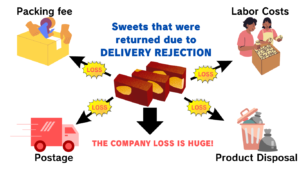
Food products with an expiration date carry risks, such as the expiration date having already passed (or being very close) by the time they are returned.
To avoid wasting valuable products due to such risks, it’s essential to implement measures against refusal of receipt.
[Reason 3] Malicious refusals to receive goods are repeated
Malicious refusal to accept, such as prank orders, is likely to occur repeatedly, not just once.
If you do not take measures against refusal to accept, such malicious refusals to accept will continue.
Companies suffering from malicious refusals to accept, such as prank orders, should take immediate action, such as introducing a fraudulent order detection system.
Four Measures to Prevent Refusal to Receive
As mentioned above, if companies do not take measures to prevent customers from refusing to receive products, damages will occur.
Therefore, we recommend taking the following four measures:
- Place a warning on the e-commerce site
- Contact the customer for confirmation before shipping
- Consider legal action
- Implement a fraudulent order detection system
We will explain each of these in detail below.
These are actual measures taken by various businesses to prevent refusal of receipt, so please use them as a reference.
[Measure 1] Place a warning on e-commerce sites
Companies should clearly state their strict policy regarding refused deliveries on their e-commerce websites.
Especially for cash-on-delivery products, there are many cases where customers refuse to accept them because they were unable to prepare the money, etc.
Furthermore, if you do not include information on how to handle refused deliveries or warnings on your e-commerce site, you risk encountering the following problems.
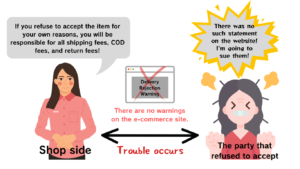
To prevent a decline in operational efficiency due to trouble, be sure to include a warning about refusal to receive on your e-commerce site.
[Countermeasure 2] Contact the recipient for confirmation before shipping
If you receive a cash-on-delivery order, it’s also a good idea to contact the customer to confirm before shipping.
While not all legitimate orderers will respond, reconfirming their intent to purchase can prevent refused deliveries.
However, if you have a large number of orders, it can be a lot of work to contact each customer individually.
Therefore, it might be a good idea to set up a system to send an email specifically to cash-on-delivery customers, warning them about the consequences of refusing delivery.
[Countermeasure 3] Consider legal action
If the customer refuses to bear the loss incurred due to the refusal to receive the package, consider legal action.
You should take strict measures especially for malicious prank orders that are considered highly egregious.
If you are considering legal action, consult with a specialized lawyer.
[Countermeasure 4] Introduce a fraud detection service
To avoid corporate losses due to refused deliveries, consider introducing a fraud detection service.
A fraudulent order detection system rigorously screens based on vast amounts of information to prevent repeat prank orders and malicious refused deliveries.
Since manually identifying fraudulent orders is a difficult task, leverage the power of a fraud detection service to improve operational efficiency.
If you’re looking for a fraud detection service to counter delivery refusal, ‘O-PLUX’ is highly recommended.
If you’re considering introducing a fraudulent order detection system as a measure against refused receipts, we recommend “O-PLUX“, developed and provided by Cacco Inc., which operates this site.
O-PLUX boasts the highest implementation rate in Japan (※), enabling highly accurate detection by real-time analysis of a vast amount of information from over 120,000 sites cumulatively. (※As of March 31, 2025, according to a survey by Tokyo Shoko Research, Ltd. on the number of paid fraud detection services introduced on e-commerce sites in Japan)
With unparalleled accuracy in Japan, it instantly catches various fraudulent
Summary
Order rejections are a troubling issue for businesses, and as the number of rejections increases, so do a company’s losses.
Not all customers who reject an order due to their own circumstances will bear the “shipping fees, cash-on-delivery fees, and return processing fees.”
In some cases, it might even be a “prank order” from someone who has no intention of receiving the product, and often, businesses just have to accept the loss because they cannot get in contact with the customer after the rejection.
Therefore, it is crucial for businesses to implement measures against order rejections to avoid unnecessary losses caused by them.
Here are four ways to prevent refused deliveries:
- Place a warning on your e-commerce site.
- Contact the customer for confirmation before shipping.
- Consider legal action.
- Implement a fraudulent order detection system.
Companies that are struggling with a high number of refused deliveries or a decrease in employee efficiency due to handling refused deliveries should consider implementing an unauthorized order detection system.
Cacco Inc.‘s fraud detection service, “O-PLUX,” can completely solve these problems.
Regarding arbitrary rejections, do not give in, but respond with a firm stance and take thorough measures to eliminate such rejections.